Lesson One Teaching Guide:
Let’s begin with suggested timings for today’s 1 hour class:
Get seated and settled - Class Intro (up to 10 mins)
Read/Listen to Lesson Story and review Demo board exercises (20 mins)
Students play on individual boards with partners. (20 mins)
Cleanup (5 mins)
Regroup/Debrief for review and awards for daily challenges completed. (5 mins) * See Explanation of Incentives below for more details.
(First Class) Intro to Class:
Discuss “housekeeping” = names, class rules, dismissal procedures, and chess etiquette. This will take longer on the first day. Adjust timings to reflect this change.
Story + Demo Board Exercises/ Puzzles:
Story: Intro to King Mateo & the Missing Animals.
Demo board: Demonstrate how the K & P’s move and block. Show how P’s get “Stuck like Chuck”. Demonstrate how to play Pawn wars - no capturing of pieces today, only moving and blocking.
Game Instructions: Pawn Wars! The King vs 1-3 Puppy Pawns to start.
Game Objective/How to Win:
Objective of the game is to get a player to the opposite side of the board first to win. The King and Pawns should try to block each others progress. Each player is to switch roles/sides after the completion of a game. This way each experiences playing as the King and the pawns. After each completed game, add another pawn to the pawn group, making it more challenging for the King to escape.
Practical Skills Learned:
Class Rules, Chess etiquette, How the King and Pawns move and block through a mini-game called ‘Pawn Wars’. Plus, Steepling/Finger Tenting (a gesture that helps us to concentrate and plan when it’s not our turn to move. Plus it’s very evil villain and makes our opponent quite ill at ease.) ;)
Emotional Skills Learned:
Patience, Self-Control, Courage
Daily Challenge:
Get King or Pawn to the other side of the board (opposite you)/the last rank = WIN! + 10 bonus points.
Review Questions for Lesson One: (Suggestions)
Who can explain why King Mateo was nervous to be King?
What forced him out of his comfort zone and on an adventure?
How did he move through the forest/ Fast, Medium, Slow?
Did Harry, the Puppy Pawn, move like the King? Did he have a special way of moving?
When did Harry use his speacial move (jumping forward) than the King?
Introduce Game:
Who is ready to meet King Mateo and his friends Harry? Would you like to play a game that they invented? Let’s play “Got’cha!”
Post Game Debrief:
Review how the game went, if there were any problems/successes. Give prizes/awards for challenges completed. (This applies to the incentive system. See page 14 for more details.)
Demo Board Setup and Explanations:
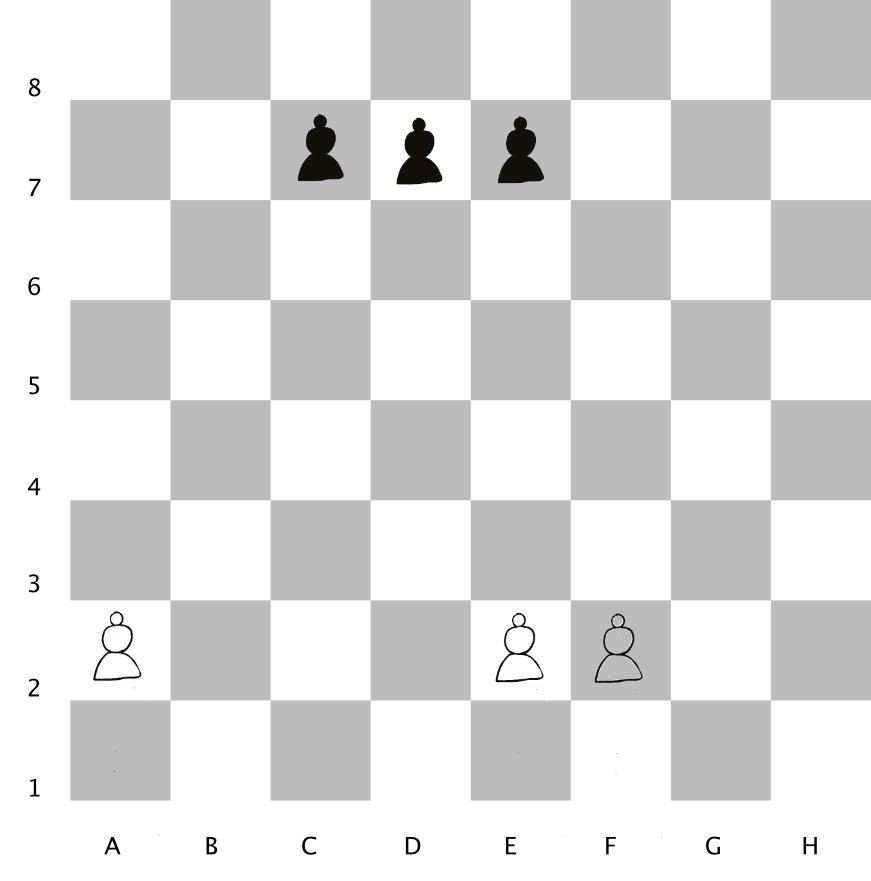
Board 1: This is one way to begin a game of Pawn Wars. You can use any equal number of pawns. The objective is to get one of your pawns to the opposite side of the board before your opponent does. Remember that pawns become “Stuck like Chuck” when an object (here, a pawn) steps into its direct path. You can do this on purpose to block your opponent’s pawn progression.
Don’t forget that any pawn can choose to jump forward two squares on it’s first move. Then it reverts back to moving one step/square per turn. Demonstrate a game on the Demo Board. Add the King after the 1st game.
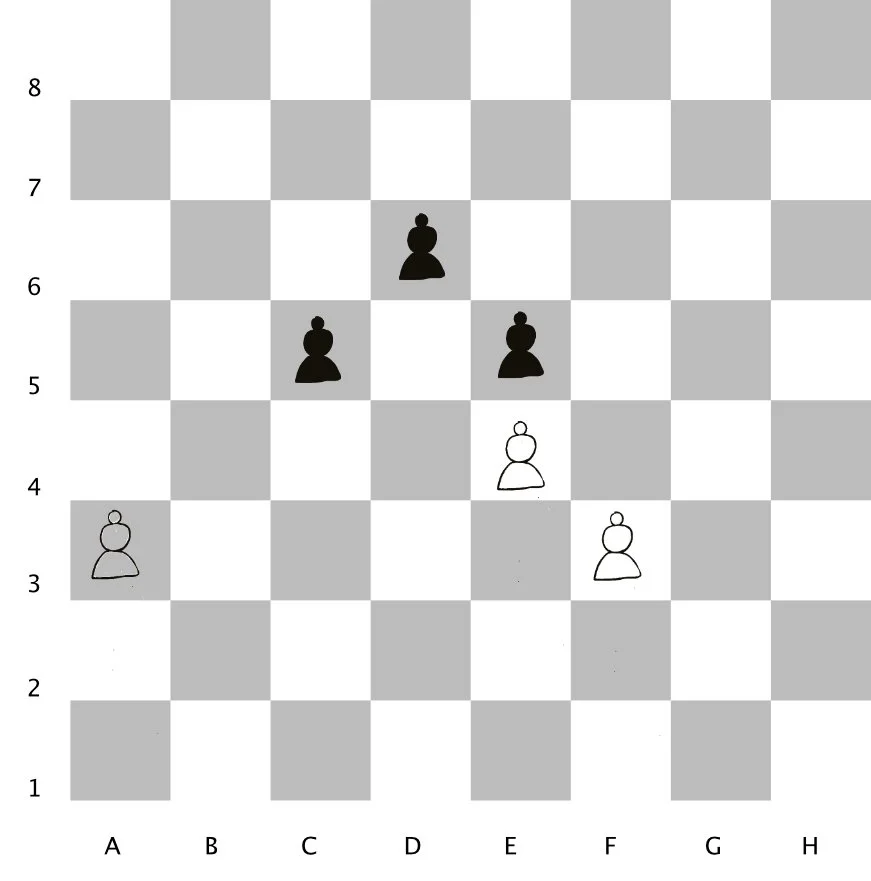
Board 2: Here we see a game in progress.
What is happening with the two pawns facing each other? (Stuck like Chuck) Who do you think might make it to the other side first?
Let’s see!
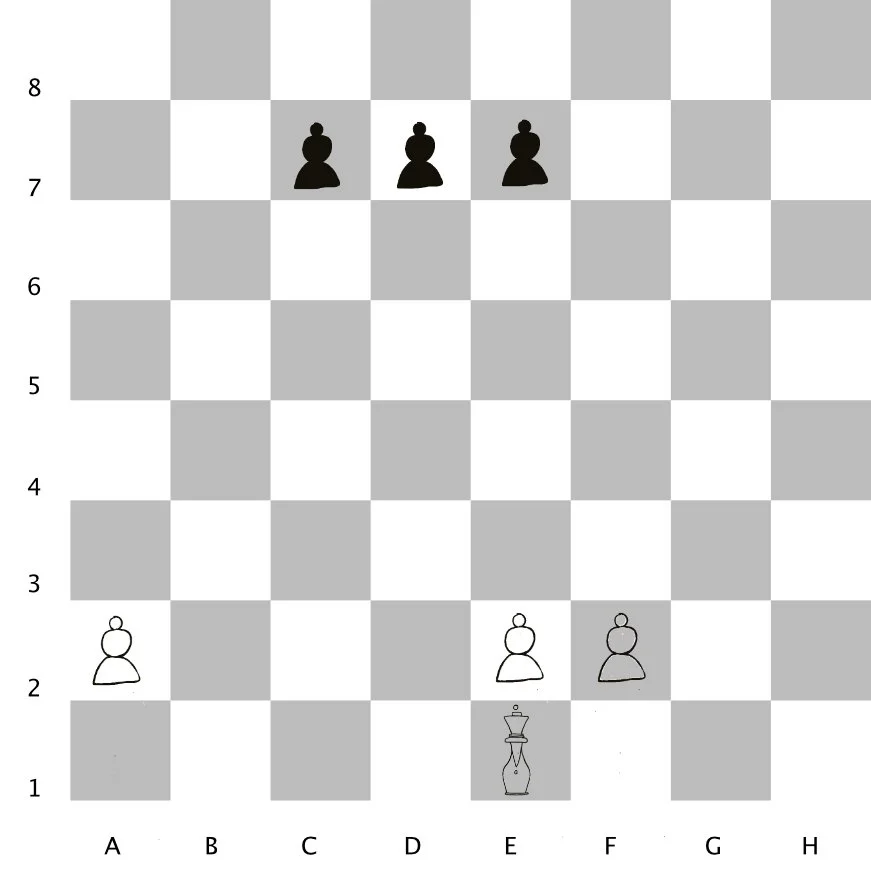
Board 3: Now, let’s bring the King into the game! He begins his journey by standing on the E square. Remember, the King and the Pawns move in similar ways, but not completely the same. Let’s see if you can spot the differences?
(Run through a few moves with the Pawns and the King. Difference: the King can only ever move one step at a time, while the Pawns can jump ahead two steps on their first move off of their original squares.)
Now it’s your turn to play Pawn Wars! Pick a partner and find a board!
Remember to take turns playing the team with the King!
* Piece Abbreviations
Kings = K, Puppy Pawns = P
*EXPLANATION OF INCENTIVES (Optional):
There are various methods for the use of incentives You may already have your own system. If not, here are a couple of ideas that have been proven successful.
Bonus Points: For each right answer during demo board exercises/puzzles, completing daily challenges, and/or outstanding behavior/chess etiquette, children can earn points to be later cashed in for: in-person colorful chess pieces, or online character cards (equivalent to physical chess pieces). You may want to limit the amount of days/times when they can cash points in to specific “Cash In Days”. Using this system does require the daily tallying of points per student. We recommend you create a physical or digital spreadsheet to keep track.
Chess Pieces/Character Cards Only: Players can earn special colorful chess pieces (sold online). Instead of accruing points to be converted into pieces, we just award pieces. They can then trade in pieces according to each pieces’ value for “better” or more valuable pieces.
ie, Pawn = 1, Knight = 3, Bishop = 3, Rook = 5, Queen = 9, King = 20 (for incentive, K = Infinity in games)
Pieces can be purchased by school/teacher. Would recommend purchasing a greater quantity of colorful pawns than of the other pieces, especially at the beginning of the school year/private lessons.
The pieces can also be used on the board during regular play as long as the students stick to using one color per side so as not to confuse which pieces belong to which player. The objective would be to earn enough pieces to complete a full board. = Certified Chess Ninja Level 1.