Lesson Eighteen Teaching Guide:
Suggested timings for today’s 1 hour class:
Get seated and settled - Class Intro (5 mins)
Read/Listen to Lesson/Story and review Demo board exercises (20 mins)
Students play on individual boards with partners. (25 mins)
Cleanup (5 mins)
Regroup/Debrief for review and awards for daily challenges completed. (5 mins)
Summary: Briefly review of last week’s lesson + chess challenge. Cover today’s story, demo board exercises + review questions, and the daily challenge.
Story + Demo Board Exercises & Puzzles:
Story: At dawn, Gemma and her friends arrive at a quiet village filled with music and secrets. A strange warning song hints that danger can come faster than expected, and a hidden chess challenge is revealed. With the Savannah Olympics about to begin, the group must decide how to prepare—because one wrong move could end everything.
Demo board: Review the concept of checkmate patterns. Demonstrate Fool’s Mate. Focus on helping the students to memorise the pattern so that they are able to recognise when someone tries to us this pattern to checkmate their King. Practice doing the pattern and defending against this pattern.
Game Instructions: Full boards
Game Objective/How to Win:
Checkmate the King to win! Most points captured wins if no checkmate occurs.
Practical Skilled Learned:
This lesson introduces students to checkmate patterns, preparing them to recognize danger early. It also reinforces that slowing down helps us make safer choices.
Emotional Skills Learned:
Becoming yourself is a real superpower. We have worth as unique individuals. How to manage envy and comparison (envy is a signal, not a sign of failure. It points to unmet needs or unrecognised strengths. But be careful to keep it I check otherwise it can overpower you!). Courage is found in action, not in status. Leadership through service.
Daily Challenge:
Promote one of your pawns by reaching your opponents side of the board (with a pawn).
Review Questions for Lesson Eighteen: (Suggestions)
What is a checkmate pattern? How would you describe one?
How does Fool’s Mate begin? Which move first made the King unsafe, and why?
Can we prevent Fool’s Mate from happening?
Why is recognising danger early, important?
How can learning patterns help you to stay safe?
Why do the giraffes sing that the first two moves matter so much?
Can moving or taking action too quickly in real life cause problems, like I’m chess?
Can being tired affect the choices we make? If we’ve an important decision to make and we’re tired… should we push through or rest before choosing our next move?
Introduce Game:
Ok everyone, time to choose a partner!
Post Game Debrief:
Review how the game went, if there were any problems/successes. Give prizes for challenges completed.
Piece Abbreviations
Kings = K, Puppy Pawns = P, Bull Rooks = R, Pony Boy Knights = N, Billy Goat Bishops = B, Queen Giraffes = Q
Piece Values: (See lesson 3 & 10)
K = Infinity
P’s = 1 pt each
R’s = 5 pts each
N’s = 3 pts each
B’s = 3 pts each
Q’s = 9 pts each
Demo Board Setup and Explanations:
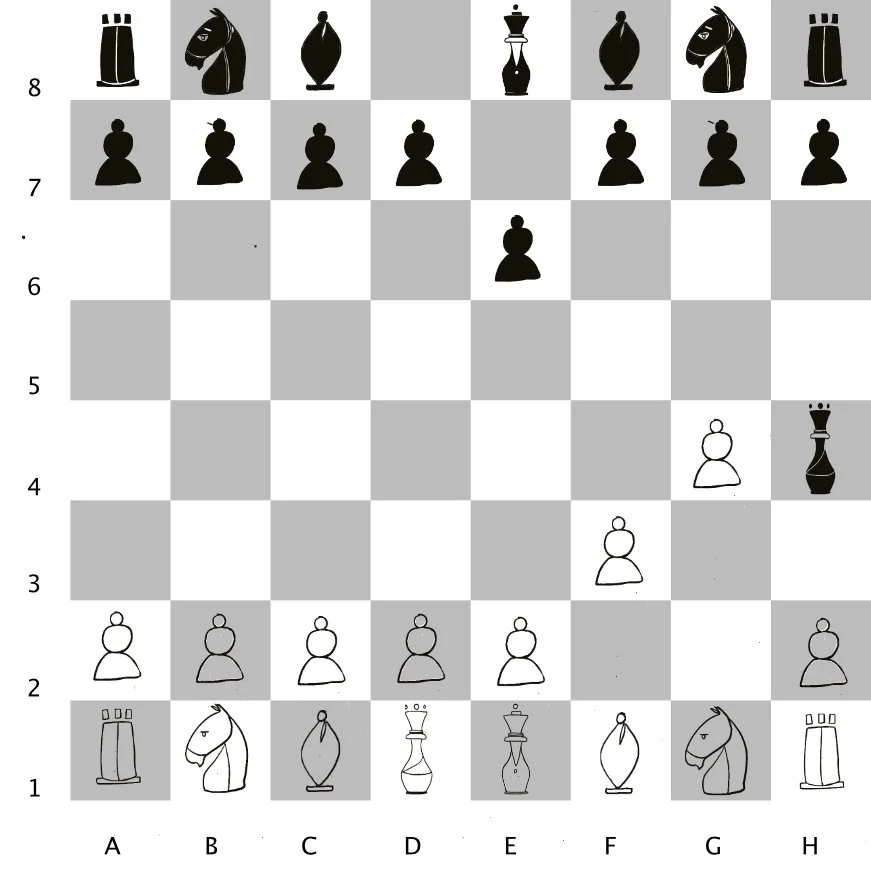
Board 1: Here we have a completed Fool’s Mate? But how did they get here? And how can you checkmate your opponent in record time? Or prevent your King from being checkmated? Follow the code below to see for your self. Begin the sequence with a full board in their starting squares. As always, white begins play.
Fool’s Mate Pattern:
f3, e6 (white moves f pawn to f3, black moves e pawn to e6
g4, Qh4# (white moves g pawn to g4, black moves Q down the open diagonal to h4 for the checkmate in two moves! # = checkmate)
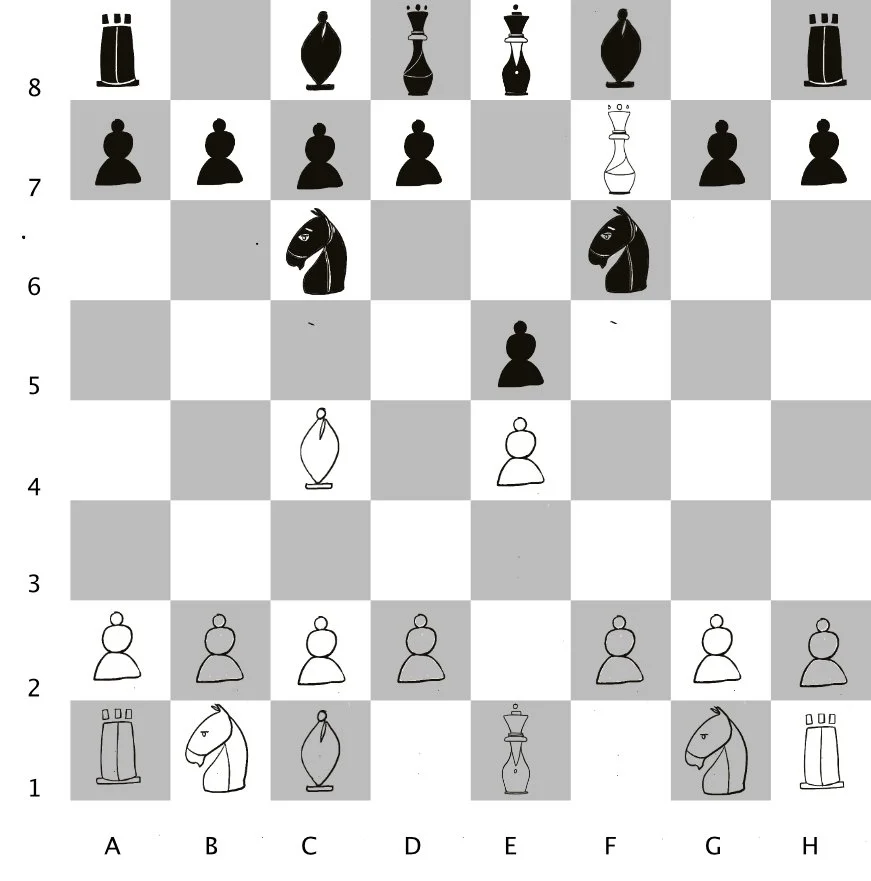
Board 2: Now here is another pattern you can try out at home! It’s called Scholar’s Mate. This is a pattern that leads to checkmate in four moves! But which side is in checkmate? That’s for your to solve! Begin the sequence with a full board in their starting positions.
Scholar’s Mate Pattern:
e4, e5 (white moves 3 pawn to e5, black moves e pawn to e5)
Bc4, Nc6 (white moves kingside B to c4, attacking black’s f pawn, Black moves it’s queenside N to c6)
Qh5, Nf6 (white Q moves to h5, attacking the black f pawn, black kingside N moves to f6. Good move? Why/why not?
Qxf7# (white Q captures f7 for checkmate)